
Shop
UAE
1 shirts
UAE Jerseys: Represent the Pride of the United Arab Emirates
Show your loyalty to the UAE National Team with our premium range of UAE jerseys. Whether supporting the team in international competitions or wearing it casually, we stock both versions:
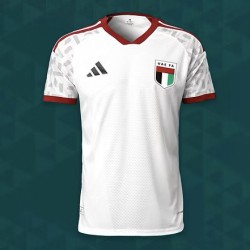
- The Player Jersey : the exact shirt worn by players on the pitch. Features an athletic fit, advanced moisture-wicking technology, and lightweight federation crests.
- The Fan Jersey : designed for ultimate supporter comfort. Features a regular fit and high-quality embroidered UAEFA crest, perfect for everyday wear.
Browse the latest Home and Away kits for the United Arab Emirates. Complete your look with custom lettering and custom player numbering.
There is 1 product.
Active filters
Prochains matchs :
Classement en direct :
History of the United Arab Emirates National Team: Al-Abyad, from Italia 90 to the 2025 Play-Off
A young nation founded in 1971, the United Arab Emirates played at the 1990 World Cup, won two Gulf Cups and produced talented players such as Omar Abdulrahman and Ali Mabkhout. In 2025 they came very close to a second World Cup qualification.
1. The Birth of a National Team (1971–1989)
The UAE Football Association was created in 1971, the very year the federation of seven emirates was founded. Nicknamed Al-Abyad — "the Whites" — the national team quickly took shape around the leading clubs of Abu Dhabi, Dubai, Al Ain and Sharjah, and established itself in the regional Gulf competitions.
2. Italia 90: The Only World Cup
In 1990 the Emirates qualified for their first and only World Cup, in Italy. Drawn against eventual world champions West Germany, Colombia and Yugoslavia, they lost all three matches but scored two goals, including Khalid Ismaïl's strike against West Germany, which entered national football history. The tournament remains a landmark for a whole generation.
3. The 1996 Asian Cup and the Gulf Cups (1991–2013)
Hosting the 1996 Asian Cup, the Emirates reached the final, lost on penalties to Saudi Arabia: their best continental result. They went on to win the Gulf Cup in 2007, at home, and in 2013 in Bahrain, and took a medal at the Asian Games.
4. The Omar Abdulrahman Generation (2014–2024)
A talented generation emerged around playmaker Omar Abdulrahman — nicknamed "Amoory" and named Asian Footballer of the Year in 2016 — and striker Ali Mabkhout, who became the national team's all-time leading scorer. The Emirates reached the semi-finals of the 2015 Asian Cup, finishing third, and the last four again at the 2019 Asian Cup, which they hosted. The domestic UAE Pro League attracted many international players.
5. The 2026 Qualifying Campaign: So Close
In Asian qualifying for the 2026 World Cup, the Emirates came through several rounds to reach the fifth round, a two-legged play-off in November 2025 against Iraq for a place at the inter-confederation tournament. They lost on aggregate; Iraq would go on to qualify for the World Cup. Al-Abyad thus narrowly missed a return to the finals, thirty-six years after Italia 90.
6. Towards 2030
Since resuming in September 2026, the United Arab Emirates have continued their development with the aim of returning to the World Cup. With modern infrastructure, regular hosting of major events such as the Club World Cup, and ambitious development and naturalisation policies, they aim to turn their Asian consistency into World Cup qualification.
Honours, Stadium and Legends
Honours: two Gulf Cups (2007 at home, 2013 in Bahrain) and an Asian Cup final in 1996, lost on penalties to Saudi Arabia in front of its own fans; third place at the 2015 Asian Cup. The United Arab Emirates' only World Cup appearance came in 1990 in Italy under Brazilian coach Carlos Alberto Parreira: Khalid Ismail scored against West Germany and Ali Thani against Yugoslavia. Abu Dhabi's Zayed Sports City Stadium is its flagship venue. Adnan Al-Talyani, the legend of the 1980s and 1990s, Ismail Matar, Omar Abdulrahman, the 2016 Asian Footballer of the Year, and Ali Mabkhout, the national team's all-time leading scorer, form its pantheon. The clubs Al-Ain, winners of the AFC Champions League in 2003 and 2024, Al-Jazira, Shabab Al-Ahli and Sharjah feed the national team, and the country's naturalisation of several foreign-born players in the 2020s has reshaped a squad that dreams of a second World Cup.