

Season 2026 / 2027
Shop
Chile
1 shirts
Chile Jerseys: Represent the Pride of La Roja
Show your loyalty to the Chilean National Team with our premium range of Chile jerseys. We stock both versions for the 2025/2026 season to suit every supporter:
- The Player Jersey : the exact shirt worn by players on the pitch. Features an athletic fit, advanced moisture-wicking technology, and lightweight heat-applied federation crests.
- The Fan Jersey : designed for ultimate supporter comfort. Features a regular fit and high-quality embroidered federation crest, perfect for everyday wear in the iconic red and blue colors.
Browse the latest Home and Away kits for Chile. Complete your look with custom lettering and custom player numbering.
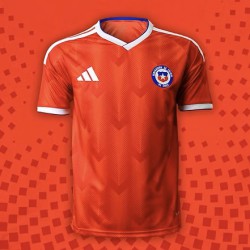
There is 1 product.
Active filters
Prochains matchs :
Classement en direct :
History of the Chile National Team: La Roja, the 1962 World Cup and Two Copa América Titles
Hosts of the 1962 World Cup and back-to-back Copa América winners in 2015 and 2016 with an exceptional generation, Chile have since been through a period of rebuilding: they missed a third consecutive World Cup in 2026.
1. Pioneers of South American Football (1895–1961)
The Chilean federation was founded in 1895, making it one of the oldest in the world. Chile were a founding member of CONMEBOL in 1916 and took part in the first World Cup, in 1930 in Uruguay, winning two of their three matches.
2. 1962: The Home World Cup and Third Place
Two years after the Valdivia earthquake, the most powerful ever recorded, Chile hosted the 1962 World Cup, driven by the famous words of organiser Carlos Dittborn: "Because we have nothing, we will do everything." On the pitch La Roja produced the best run in their history: they beat the USSR in the quarter-finals, lost to Garrincha's Brazil in the semi-final and took third place against Yugoslavia. The tournament is also remembered for the "Battle of Santiago" against Italy, one of the most violent matches in history.
3. Salas, Zamorano and the 1998 Return (1963–2009)
After several World Cup appearances (1966, 1974, 1982), Chile were suspended in 1989 following the incident involving goalkeeper Roberto Rojas in a qualifier at the Maracanã. They returned in 1998 in France, driven by the strike partnership of Marcelo Salas and Iván Zamorano, and reached the round of 16.
4. The Golden Generation: Bielsa, Sampaoli and Two Copa América Titles (2010–2017)
The arrival of Argentine coach Marcelo Bielsa transformed the team: intense pressing, attacking football and a round-of-16 place in 2010. An exceptional generation blossomed: Alexis Sánchez, Arturo Vidal, Claudio Bravo, Gary Medel, Charles Aránguiz and Eduardo Vargas. Under Jorge Sampaoli, Chile knocked out world champions Spain at the 2014 World Cup, then won the 2015 Copa América at home, their first major title, beating Messi's Argentina on penalties. A year later they repeated the feat at the 2016 Copa América Centenario in the United States, again on penalties against Argentina. They also reached the 2017 Confederations Cup final.
5. The End of a Cycle and the 2026 World Cup (2018–2026)
The ageing of the golden generation brought absences from the 2018 and 2022 World Cups. Qualifying for 2026 confirmed that difficult period: Chile finished outside both the six direct South American places and the play-off spot, missing a third consecutive World Cup.
6. Towards 2030: Rebuilding La Roja
Since resuming in September 2026, Chile have begun a thorough rebuild around a new generation, aiming to recover the level they reached in the mid-2010s. The 2030 World Cup, whose first matches will be played in South America to mark the centenary, is a rallying objective.
Honours, Stadium and Legends
Honours: two consecutive Copa América titles, in 2015 at home and at the 2016 Centenario edition in the United States, both won on penalties against Argentina. Host of the 1962 World Cup despite the devastating 1960 Valdivia earthquake, Chile finished third, its best World Cup result. Santiago's Estadio Nacional, opened in 1938, is the heart of its history. Elías Figueroa, one of the finest South American defenders of all time, Carlos Caszely, Iván Zamorano, Marcelo Salas, goalkeeper Claudio Bravo, Arturo Vidal, Gary Medel and Alexis Sánchez, the all-time leading scorer and most-capped player, form its pantheon, driven by the tactical legacy of Marcelo Bielsa and Jorge Sampaoli, whose high-pressing, fearless style made "La Roja" one of the most admired teams in the world in the mid-2010s.