

Season 2026 / 2027
Shop
AS Roma
1 shirts
AS Roma Shirts: Represent the Pride of the Eternal City
Show your loyalty to the legendary Giallorossi with our premium range of AS Roma jerseys. We stock both versions for the 2025/2026 season to suit every supporter:
- The Player Jersey : the exact shirt worn by the players on the pitch. Features an athletic fit, advanced moisture-wicking technology, and lightweight heat-applied crests.
- The Fan Jersey : designed for ultimate supporter comfort. Features a regular fit and high-quality embroidered club crest, perfect for everyday wear.
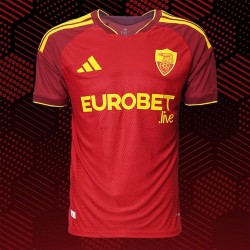
Browse the latest Home, Away, and Third kits for AS Roma. Complete your look with custom Serie A-style lettering and custom player numbering.
There is 1 product.
Active filters
Prochains matchs :
Classement en direct :
History of AS Roma: The Giallorossi, Totti and the Passion of the Eternal City
Founded to give the capital a club capable of challenging the giants of the North, AS Roma have won three scudetti, a European trophy in 2022 and produced a unique legend: Francesco Totti, twenty-five years in the same shirt.
1. A Merger to Challenge the North (1927–1940)
On 7 June 1927, on the initiative of Italo Foschi, three clubs from the capital — Alba-Audace, Fortitudo and Roman — merged to create the Associazione Sportiva Roma. The goal was clear: build a team able to compete with the powers of Turin, Milan and Genoa. Only Lazio refused to join, giving birth to the Derby della Capitale, one of the most passionate in the world. The club adopted yellow and red, the city's historic colours, and the Capitoline she-wolf as its emblem, playing at the small Testaccio ground in a working-class district.
2. A First Scudetto and Difficult Years (1941–1979)
Roma won their first league title in 1942. The post-war period was mixed, including relegation in 1951. The club won the 1961 Inter-Cities Fairs Cup and several Coppa Italia titles, but the scudetto proved elusive.
3. Falcão, Liedholm and the 1984 Final (1980–1991)
Under Swedish coach Nils Liedholm and with Brazilian Paulo Roberto Falcão, nicknamed "the eighth king of Rome", Roma won their second scudetto in 1983. The following year they reached the 1984 European Cup final, played in their own Stadio Olimpico, but lost on penalties to Liverpool — one of the greatest heartbreaks in the club's history.
4. Totti, Capello and the 2001 Title (1992–2016)
In 1993 a sixteen-year-old Roman, Francesco Totti, made his debut. He would become captain, soul and all-time leading scorer of the club, turning down every offer from Europe's biggest clubs. Under Fabio Capello, with Gabriel Batistuta, Vincenzo Montella and Cafu, Roma won their third scudetto in 2001. Many second-place finishes followed, along with two Coppa Italia titles (2007, 2008).
5. The Remontada, Mourinho and a European Trophy (2017–2023)
Totti retired in 2017 after twenty-five seasons, in an emotional farewell at the Stadio Olimpico. In 2018 Roma produced one of the great Champions League comebacks, overturning FC Barcelona 3–0 in the quarter-final second leg after a 4–1 first-leg defeat, before reaching the semi-finals. Bought by the American Friedkin family in 2020, the club appointed José Mourinho, who delivered in 2022 the very first Conference League, won 1–0 against Feyenoord in Tirana: the first UEFA trophy in Giallorossi history. The following year Roma lost the Europa League final on penalties to Sevilla.
6. The 2025–26 Season
In 2025–26 Roma continued their rebuild, aiming to return durably to the top of Serie A and to the Champions League. The league title went to Inter Milan, who completed a double, while the Italian national team, featuring several Roma players, missed the 2026 World Cup.
7. Looking to 2026–27: A New Stadium and New Ambitions
Since the restart, Roma have been pursuing two major projects: re-establishing themselves among Italy's best clubs and building their own stadium at Pietralata, eventually replacing the Stadio Olimpico shared with Lazio. Backed by one of the most fervent crowds in Europe, the club remains faithful to its founders' mission: to make the name of Rome shine.
Honours, Stadium and Legends
Main honours: three Italian championships (1942, 1983, 2001), nine Coppa Italia titles (1964, 1969, 1980, 1981, 1984, 1986, 1991, 2007, 2008), two Italian Super Cups (2001, 2007), one Inter-Cities Fairs Cup (1961) and one Europa Conference League (2022). Roma play at the Stadio Olimpico, built for the 1960 Olympics and shared with Lazio, where the famous Curva Sud produces some of the finest choreographies in Europe. The Trigoria training centre houses the first team and the academy.
The legends: Francesco Totti holds the club's appearance and scoring records after twenty-five seasons and more than seven hundred and eighty matches. Daniele De Rossi, nicknamed "Capitan Futuro", spent almost eighteen years in the first team before returning as coach. Agostino Di Bartolomei, captain of the 1983 scudetto, Bruno Conti, a 1982 world champion, Roberto Pruzzo, Giacomo Losi, Brazilian defender Aldair, whose number 6 shirt was long retired, and Vincenzo Montella all shaped Giallorossi history.
Identity: yellow and red are the historic colours of the municipality of Rome, and the she-wolf suckling Romulus and Remus has adorned the crest since the club's foundation. The Derby della Capitale against Lazio divides the city like no other fixture in Italian football: families, neighbourhoods and workplaces split between the two camps, and the atmosphere in the Olimpico on derby day, with rival choreographies facing each other from the Curva Sud and the Curva Nord, is among the most spectacular in the sport.
Rivalries and Supporter Culture
The Derby della Capitale against Lazio has divided Rome since 1929 and remains one of the most intense in Europe. The Capitoline She-wolf on the crest, the city's yellow and red colours and the Curva Sud of the Stadio Olimpico form the Giallorossi soul, while Antonello Venditti's anthem "Roma Roma Roma" rings out before every home match.