
Shop
Norway
1 shirts
Norway Jerseys: Represent the Løvene Pride
Show your loyalty to the Norway National Team with our premium range of Norway jerseys. We stock both versions for the 2025/2026 season to suit every supporter:
- The Player Jersey : the exact shirt worn by players on the pitch. Features an athletic fit, advanced moisture-wicking technology, and lightweight heat-applied federation crests.
- The Fan Jersey : designed for ultimate supporter comfort. Features a regular fit and high-quality embroidered NFF crest, perfect for everyday wear in the iconic red, blue, and white colors.
Browse the latest Home and Away kits for Norway. Complete your look with custom lettering and custom player numbering.
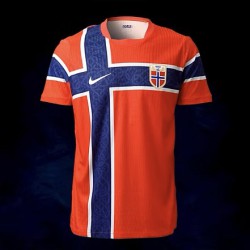
There is 1 product.
Active filters
Prochains matchs :
Classement en direct :
History of the Norway National Team: From Berlin Bronze to the 2026 Quarter-Final
Absent from major tournaments for twenty-eight years, Norway made a thunderous return at the 2026 World Cup: victory over Brazil and a historic quarter-final against England. A generation led by Erling Haaland and Martin Ødegaard has woken an entire country.
1. Beginnings and the 1936 Olympic Feat
The Football Association of Norway was founded in 1902. Its first great achievement came at the 1936 Berlin Olympics: in front of Adolf Hitler, Norway beat Germany 2–0 in the quarter-finals and went on to win the bronze medal. Two years later they played their first World Cup in France and took eventual champions Italy to extra time.
2. The Years as Outsiders (1950–1989)
Long modest, Norwegian football produced a few famous upsets, the best known being the 2–1 win over England in 1981 in Oslo, immortalised by commentator Bjørge Lillelien's impassioned words, which became legendary across Europe.
3. The Egil Olsen Era: Second in the World (1990–1998)
Under Egil "Drillo" Olsen, Norway became one of Europe's most feared teams with a direct, disciplined game. They reached second place in the FIFA rankings in the 1990s, qualified for the 1994 and 1998 World Cups and, in France in 1998, beat Brazil 2–1 in the group stage before reaching the round of 16.
4. Twenty-Eight Years Away and a New Generation (1999–2025)
After Euro 2000, Norway disappeared from major tournaments for more than two decades. Renewal came through an exceptional generation: Martin Ødegaard, captain and playmaker, and above all Erling Haaland, one of the most prolific strikers in history. On 16 November 2025 Norway qualified for the 2026 World Cup by finishing ahead of Italy, who were sent to the play-offs.
5. The 2026 World Cup: The Best Run in Their History
Ranked thirty-first in the world before the tournament, Norway were among the great revelations of the North American World Cup. After the group stage they beat Ivory Coast 2–1 in the round of 32 on 30 June in Arlington, then pulled off the feat of eliminating Brazil 2–1 in the last 16 on 5 July in East Rutherford. In the quarter-final, on 11 July in Miami Gardens, they lost only after extra time to England (1–2). It is the best World Cup result in Norwegian football history.
Haaland, Ødegaard and a Development Revolution
The success of the 2026 generation is no accident. Since the 2000s the Norwegian federation has invested heavily in covered artificial pitches, allowing year-round play despite harsh winters, and in coach education. The country's clubs, long confined to Europe's qualifying rounds, have improved: Molde and above all Bodø/Glimt, from a town of fifty thousand people beyond the Arctic Circle, have made their mark on the European stage. Erling Haaland, born in Leeds during his father Alf-Inge's playing career and developed at Bryne, became within a few seasons the national team's all-time leading scorer. Martin Ødegaard, capped at fifteen, became its captain and creative brain.
6. Towards 2030: Joining the Big Nations
Since resuming in September 2026, Norway have begun their new cycle with unprecedented confidence. Driven by a generation at full maturity and improving domestic clubs — Bodø/Glimt eliminated Inter Milan in the 2025–26 Champions League — they now aim for a regular presence at major tournaments.
Honours, Stadium and Legends
Highlights: a bronze medal at the 1936 Berlin Olympics, after a 2-0 win over Germany in front of Adolf Hitler; World Cup finals in 1938, 1994, 1998 — with the famous 2-1 victory over holders Brazil — and 2026; Euro 2000. Under Egil "Drillo" Olsen, Norway even climbed to second in the FIFA ranking in 1993 and 1995 with a direct, physically demanding style that unsettled the biggest nations. Oslo's Ullevaal Stadion, holding around twenty-eight thousand, is its historic home. Rune Bratseth, Tore André Flo, Ole Gunnar Solskjær, John Arne Riise, the most-capped player, and Martin Ødegaard shaped its history, before Erling Haaland erased Jørgen Juve's scoring record, which had stood for almost ninety years.