

Season 2026 / 2027
Shop
SL Benfica
1 shirts
SL Benfica Shirts: Represent the Águias Pride
Show your loyalty to the iconic giants of Lisbon with our premium range of SL Benfica jerseys. We stock both versions for the 2025/2026 season to suit every supporter:
- The Player Jersey: the exact shirt worn by the players on the pitch. Features an athletic fit, advanced moisture-wicking technology, and lightweight heat-applied crests.
- The Fan Jersey: designed for ultimate supporter comfort. Features a regular fit and high-quality embroidered club crest, perfect for everyday wear.
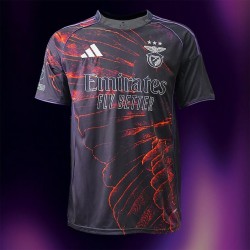
Browse the latest Home, Away, and Third kits for SL Benfica. Complete your look with custom Primeira Liga-style lettering and custom player numbering.
There is 1 product.
Active filters
Prochains matchs :
Classement en direct :
History of SL Benfica: The Eagle of Lisbon, Eusébio and the Curse of Guttmann
Portugal's most successful club, one of those with the most members in the world and back-to-back European champions in the early 1960s, Benfica are a national institution. Their history is inseparable from Eusébio — and from a legendary curse that has haunted the club for more than sixty years.
1. A People's Foundation (1904–1953)
On 28 February 1904, a group of young men meeting in a pharmacy in the Belém district founded Sport Lisboa. In 1908 it merged with Grupo Sport Benfica to become Sport Lisboa e Benfica. The club adopted red and white, an eagle as its emblem and the Latin motto E pluribus unum — "out of many, one". The people's club par excellence, it quickly became the most followed in the country and won its first national championships in the 1930s.
2. Béla Guttmann, Eusébio and Two European Cups (1954–1962)
In 1954 the club opened the Estádio da Luz. In 1959 it hired Hungarian coach Béla Guttmann, who built an attacking side and signed a young Mozambican forward of exceptional speed and power: Eusébio da Silva Ferreira. Benfica ended Real Madrid's hegemony by winning the 1961 European Cup against FC Barcelona (3–2 in Bern), then 1962 against Real Madrid themselves (5–3 in Amsterdam), with Eusébio scoring twice in the final.
3. The Curse of Guttmann (1962–1990)
After that second title, Guttmann asked for a pay rise that the board refused. He left the club pronouncing, according to legend, a curse: "Not in a hundred years will Benfica be European champions." Since then the club has played eight European finals without winning one — European Cup finals in 1963, 1965, 1968, 1988 and 1990, the UEFA Cup in 1983 and the Europa League in 2013 and 2014. Domestically, however, dominance was total: Eusébio, the 1965 Ballon d'Or winner, became one of the greatest goalscorers in history, and Benfica went through the 1972–73 league season unbeaten.
4. A National Giant and a Development Club (1991–2022)
The new Estádio da Luz, built for Euro 2004, became one of the most modern arenas in Europe. The Seixal academy, among the most renowned in the world, produced Bernardo Silva, João Félix, Rúben Dias, João Cancelo and Gonçalo Ramos, and player sales became a pillar of the economic model. The club won four consecutive titles between 2014 and 2017, reinforcing its status as Portugal's most successful club with thirty-eight championships.
5. Recent Years (2023–2026)
Champions in 2023, Benfica then saw Sporting CP win in 2024 and 2025. In 2025–26 the title went to FC Porto, six points clear of Sporting. In the Champions League, Benfica were eliminated in the play-off round by Real Madrid (1–3 on aggregate).
6. Looking to 2026–27
Since the restart, Benfica have relied on their fundamentals — an exceptional academy, one of the largest memberships in the world and a sixty-five-thousand-seat stadium — to reclaim the championship. And perhaps, at last, to lift the curse of Guttmann on the European stage.